
English version follows at the end.
Ed ancora “Il miglior modo per nascondere qualcosa è metterlo ben in vista.”
Non serve andare sul sito del Comune di Montegranaro per associare questo nome al grano dei campi gialli, tipico dei paesaggi delle Marche. Tuttavia, per confermare l’ipotesi che a molti viene in mente leggendo “Montegranaro”, il sito ufficiale del Comune riporta:
“Il nome Montegranaro deriva dal latino Mons Granarius, in relazione ai depositi di grano che i Romani collocavano strategicamente per rifornire i legionari, specialmente nelle aree di abbondante produzione cerealicola.”
A noi, però, non importava granché del nome dei posti. Eravamo troppo impegnati a sfrecciare su furgoni lungo strade polverose, come quella del Torrione di Villa San Filippo. Lì, quando si vedeva un polverone in lontananza, tutti sapevano che era una tappa di tomaie da consegnare a un tomaificio, magari senza bolla. Oppure giù per la Mezzina, mezza franata, dove le corse per portare le tappe erano così veloci che gli incidenti mortali erano più frequenti che sul circuito di Monza. La finanza era sempre pronta a fermare chi veniva beccato con una bolla sbagliata o senza bolla, emettendo multe di centinaia di migliaia di lire. Figurarsi se in tutta questa frenesia avevamo il tempo di pensare all’origine dei nomi.
Poi arrivò un prete strano, uno senza fretta. Un prete che, se non fosse stato per le sue numerose lauree, sarebbe stato considerato ignorante, non per mancanza di conoscenza, ma perché quando si metteva qualcosa in testa non c’era modo di fermarlo. Con calma e testardaggine, sfidò i grandi storici, affermando che Carlo Magno fosse originario di San Claudio e che l’intero territorio circostante avesse un significato diverso.
Da allora, tutto è stato messo in discussione, niente è piu dato per scontato e quindi neanche la certezza che Montegranaro abbia ottenuto il suo nome da un deposito di grano.
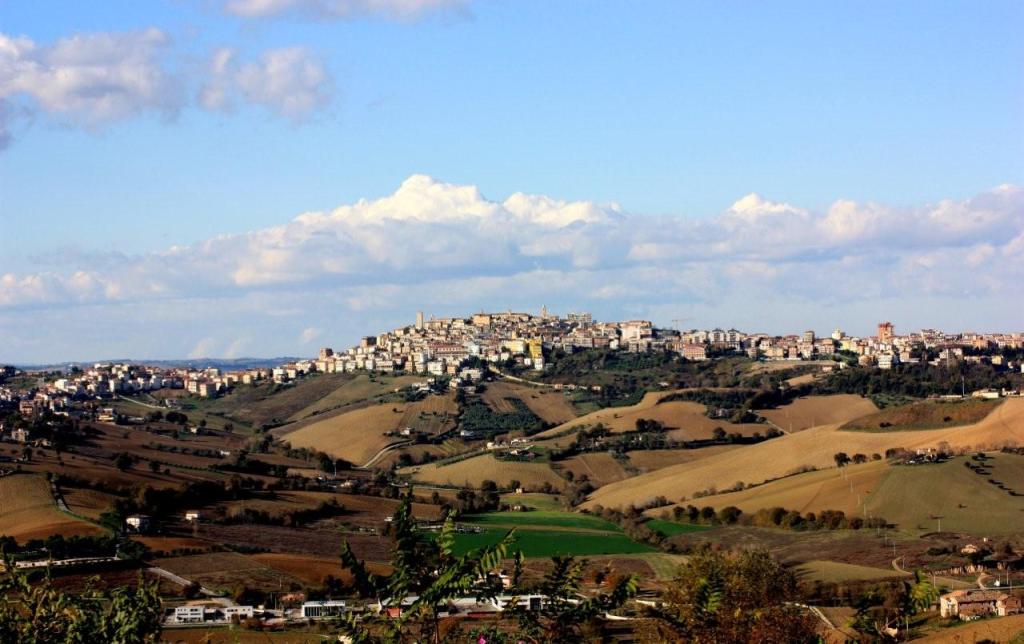
Ora ci si domanda come mai un monte su cui da una parte si ha un panorama fino a vedere il Gran Sasso e dall’ altra si vede tutta la valle del Chienti dai monti fino al mare e più in là si vede fino al Monte Conero venga chiamato con riferimento a un deposito di grano.
I paesi vicini hanno nomi di Santi, come Sant’Elpidio, Monte Giorgio e Monte San Giusto, oppure nomi curiosi come Monte Urano, Fermo, Monte Lupone. Eppure Montegranaro, il monte più alto o comunque il più impervio, porta un nome così generico. Persino i fossi della zona, come l’Ete e l’Asola, hanno nomi di origine gallica, mentre il monte più prominente sembra legato a un deposito di grano che nessuno ha mai visto.
Un deposito di grano poteva essere ovunque, e ogni monte poteva averne uno, se l’idea di portare grano in cima ai monti poteva avere un senso.
Secondo un’altra ipotesi, sempre riportata sul sito del Comune di Montegranaro, il nome potrebbe derivare dall’antichissima città romana di Beregra o Veregra, con il relativo ager Veregranus.
In latino:
- Ager significa “campo” o “territorio coltivato”.
- Veregranus potrebbe riferirsi a una divinità.
Questa seconda ipotesi potrebbe collegarsi alla teoria del prete Carnevale, che ipotizzava l’origine di Aquisgrana a San Claudio.
Esiste un legame tra Veregranus e Aquisgranum?
- Aquisgranum: il nome deriva da Aquae (acque, spesso termali) e Granum, riferito a una divinità celtica delle sorgenti termali, Grannus.
- Veregranus: il suffisso -granus potrebbe riferirsi alla stessa divinità celtica, venerata come dio della guarigione e delle acque termali. Il prefisso Vere- potrebbe significare “vero” o “verità”, un attributo sacro.
Quindi, il nome Veregra e Montegranaro potrebbe essere legato al culto del Dio Granno, divinità celtica associata alla guarigione, fertilità e, in alcuni contesti, al sole e alla terra.
Il collegamento al Dio Granno è affascinante. Sarebbe logico dedicare il nome del monte più alto a una figura divina così importante. Magari, nel tempo, si è persa una semplice “n”. E così, “Montegranaro” potrebbe essere stato, in origine, Montegrannaro, ovvero “il monte del Dio Granno”.
Photo 1: viaggiatoriweb.it
The Wheat(grano) of Montegranaro (English Version)
And again, “The best way to hide something is to put it in plain sight.”
There’s no need to visit the Municipality of Montegranaro’s website to associate this name with the golden wheat fields typical of the Marche landscape. However, to confirm the hypothesis that comes to many people’s minds when reading “Montegranaro,” the official website of the Municipality states:
“The name Montegranaro derives from the Latin Mons Granarius, referring to the grain depots that the Romans strategically placed to supply their legions, especially in areas of abundant cereal production.”
But we didn’t really care much about place names. We were too busy racing in vans along dusty roads, like the one at the Torrione in Villa San Filippo. There, when a cloud of dust appeared in the distance, everyone knew it was a delivery of uppers to a shoe factory, perhaps without proper paperwork. Or down the Mezzina road, half-collapsed, where the runs to deliver goods were so fast that fatal accidents were more frequent than on the Monza circuit. The tax authorities were always ready to stop anyone caught with incorrect or missing paperwork, issuing fines in the hundreds of thousands of lire. In all this frenzy, we certainly didn’t have time to think about the origins of names.
Then came a peculiar priest, one who was in no hurry. A priest who, if not for his many degrees, would have been considered ignorant—not for lack of knowledge but because, once he set his mind on something, there was no stopping him. Calm and stubborn, he challenged prominent historians, claiming that Charlemagne was originally from San Claudio and that the entire surrounding area held a different significance.
Since then, everything has been called into question; nothing is taken for granted anymore, including the certainty that Montegranaro got its name from a grain depot.
Now people wonder why a hill offering a view of the Gran Sasso on one side and, on the other, the entire Chienti Valley from the mountains to the sea—and beyond, even to Monte Conero—would be named after a grain depot.
Nearby towns have names of saints, like Sant’Elpidio, Monte Giorgio, and Monte San Giusto, or curious names like Monte Urano, Fermo, and Monte Lupone. Yet Montegranaro, the highest or at least the most rugged hill, bears such a generic name. Even the local streams, like the Ete and the Asola, have names of Gallic origin, while the most prominent hill seems tied to a grain depot no one has ever seen.
A grain depot could have been anywhere, and any hill could have had one—if the idea of carrying grain to hilltops made sense.
According to another hypothesis, also reported on the Municipality of Montegranaro’s website, the name might derive from the ancient Roman city of Beregra or Veregra, with its associated Ager Veregranus.
In Latin:
Ager means “field” or “cultivated land.”
Veregranus could refer to a deity.
This second hypothesis could connect to Father Carnevale’s theory, which suggested the origin of Aachen (Aquisgrana) in San Claudio.
Is there a link between Veregranus and Aquisgranum?
Aquisgranum: the name derives from Aquae (waters, often thermal) and Granum, referring to a Celtic deity of thermal springs, Grannus.
Veregranus: the suffix -granus could refer to the same Celtic deity, worshipped as the god of healing and thermal waters. The prefix Vere- could mean “true” or “truth,” a sacred attribute.
Thus, the names Veregra and Montegranaro might be linked to the cult of the god Grannus, a Celtic deity associated with healing, fertility, and, in some contexts, the sun and the earth.
The connection to the god Grannus is fascinating. It would make sense to name the highest hill after such an important divine figure. Perhaps, over time, a simple “n” was lost. And so, “Montegranaro” might originally have been “Montegrannaro,” meaning “the hill of the god Grannus.”






Rispondi