
English version follows at the end
Nel 1930, gli scavi presso la chiesa di San Salvatore a Germigny-des-Prés, in Francia, rivelarono che l’edificio originario del IX secolo era quadrato con cinque absidi. Al centro, quattro pilastri sostenevano una torre quadrata. La chiesa era divisa in nove parti, con un quadrato centrale. Tra il XV e il XVI secolo, fu estesa verso ovest, diventando rettangolare. Nel XIX secolo, fu aggiunta una sesta abside.
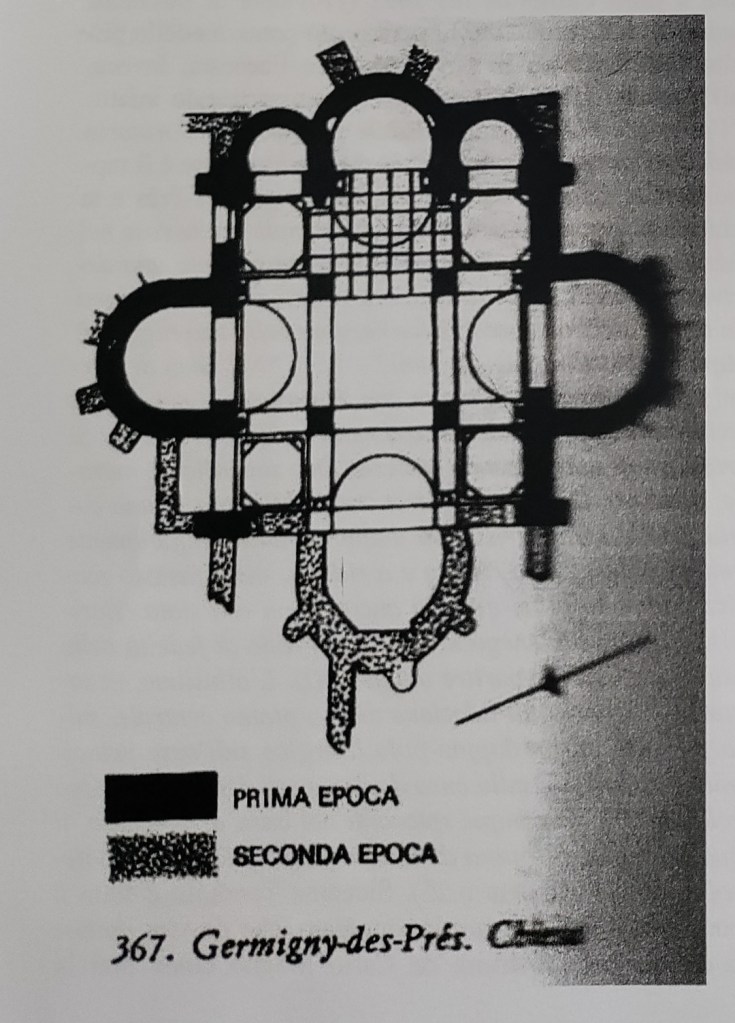
Questa chiesa inizialmente insignificante divenne molto importante dopo che lo studioso Hubert condusse gli scavi. Questi scavi rivelarono la struttura originale dell’edificio e portarono a una nuova teoria che modifica gran parte della storia medievale, rendendo obsoleti molti libri di testo scolastici.
I documenti medievali descrivono la cappella come una basilica costruita sul modello della Cappella Palatina di Aquisgrana. Tuttavia, la chiesa di Aquisgrana, già identificata dalla storiografia ufficiale come la Cappella Palatina di Aquisgrana, condivide solo uno schema planimetrico centrale.
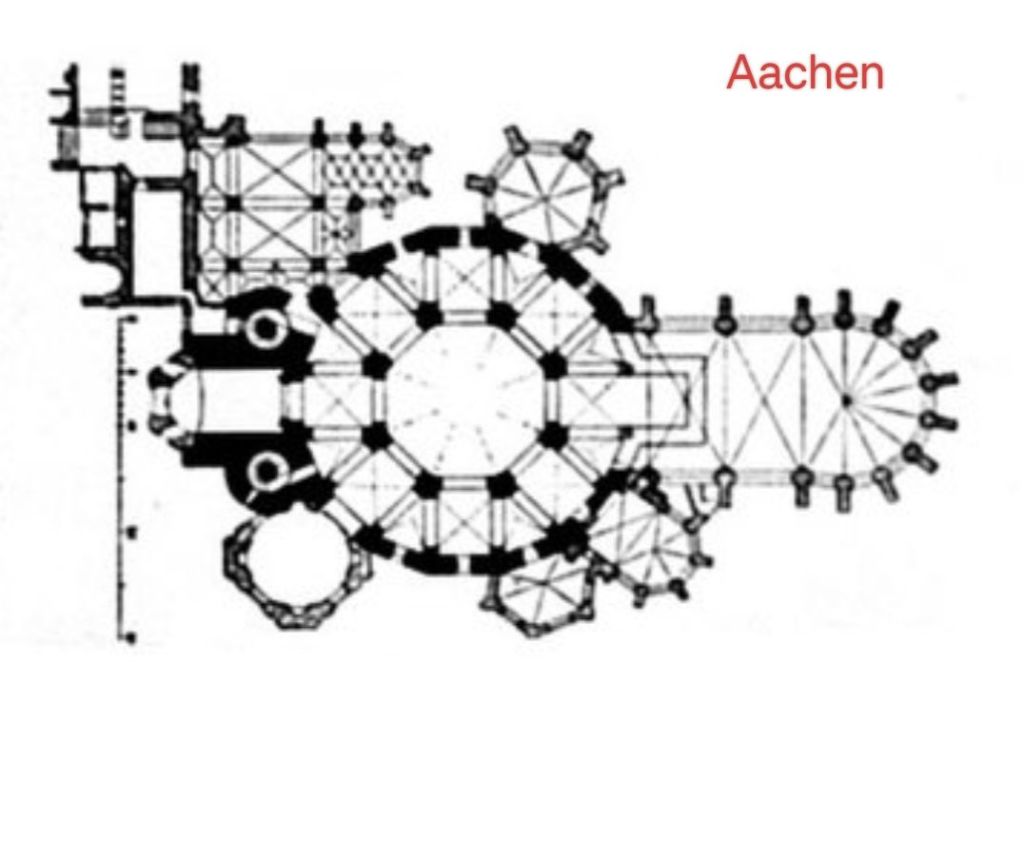
La cappella originale di Germigny-des-Prés è quadrata con cinque absidi, mentre quella di Aquisgrana (Aachen) è ottagonale e senza absidi. Inoltre, la chiesa tedesca ha otto pilastri disposti in cerchio, mentre quella francese ne ha quattro al centro.
Nel 1992, Giovanni Carnevale collegò la chiesa di San Claudio al Chienti a quella di Germigny-des-Prés. Le due chiese condividono lo stesso modello planimetrico quadrato, le stesse quattro colonne centrali, gli stessi nove campate e lo stesso numero di absidi. Questa scoperta portò all’identificazione di San Claudio al Chienti come la vera Aquisgrana.
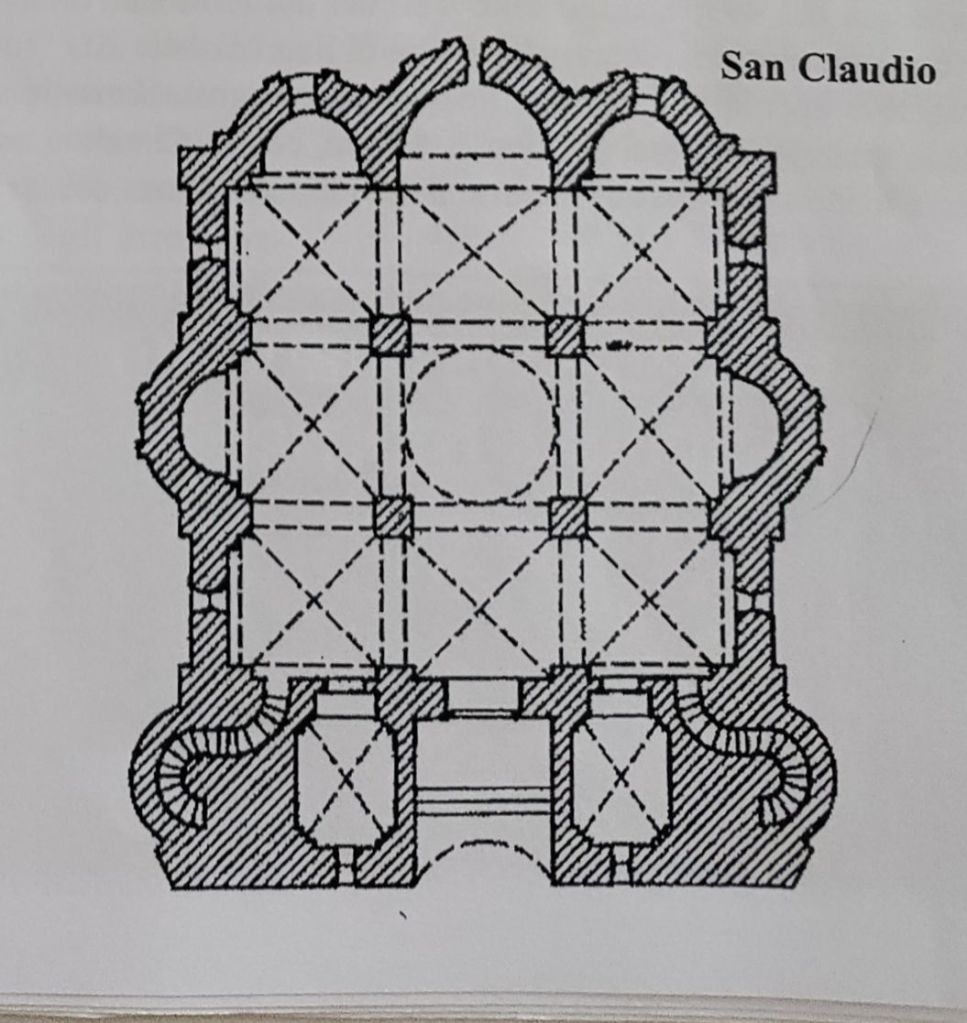
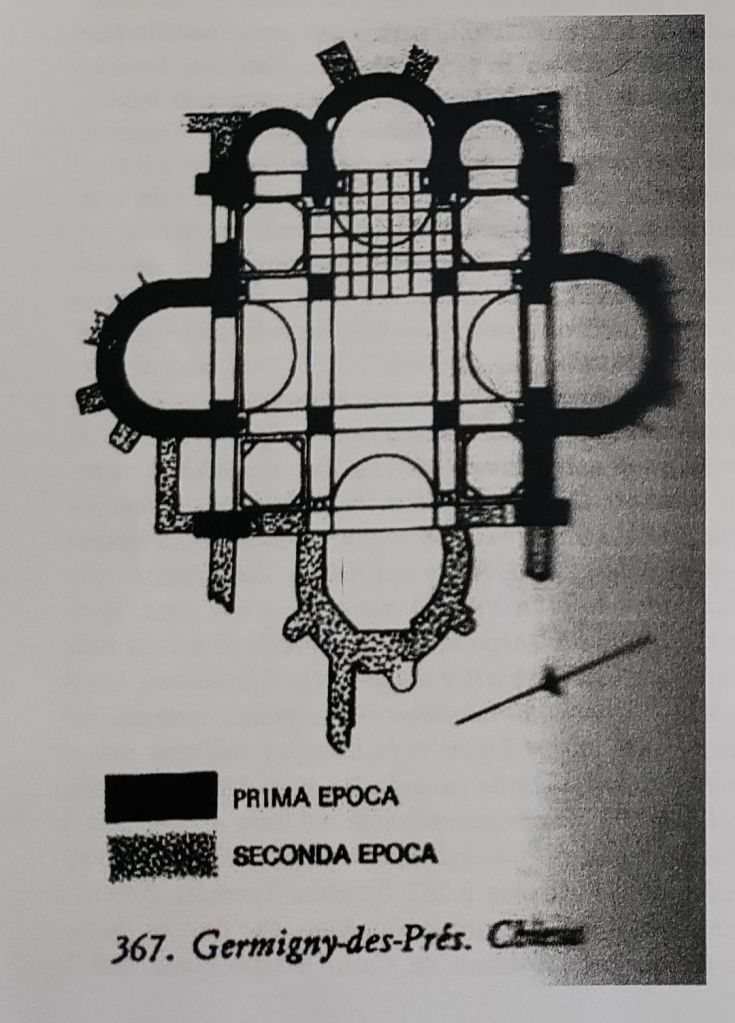
Gillo Dorfles, uno dei principali storici dell’arte del secolo scorso, osservò che il modello planimetrico quadrato diviso in nove campate, proveniente dall’Oriente, è piuttosto comune nella regione delle Marche. Dorfles confrontò i piani degli edifici di Germigny-des-Prés e San Claudio al Chienti, evidenziandone la somiglianza. Almeno 40 studiosi hanno sottolineato la particolarità della chiesa di San Claudio, con il suo piano quadrato, le quattro colonne centrali e le cinque absidi. Dorfles, noto anche per la sua vivacità, prestò attenzione alla teoria di Aachen nelle Marche, citando Giovanni Carnevale.
Nel 1993, l’anno dopo che Carnevale collegò San Claudio a Germigny-des-Prés, la giovane ricercatrice tedesca Hildegard Sahler venne nelle Marche per studiare, oltre a San Claudio, San Vittore alle Chiuse, Santa Maria delle Moje e Santa Croce dei Conti. Fino al 2010, Sahler pubblicò diversi libri, il più importante dei quali è San Claudio al Chienti e le chiese romaniche a croce greca iscritta nelle Marche.
Nel libro, Sahler commette quattro gravi errori. Afferma che l’edificio di Germigny-des-Prés ha sei absidi anziché cinque, attribuisce un’abside sul lato ovest al piano originale che fu aggiunta solo nel 1867, confonde il piano originale del 803-806 con l’estensione del XV e XVI secolo, e definisce erroneamente il tetraconco come una struttura con quattro absidi, mentre sia San Claudio che San Salvatore ne hanno cinque. Inoltre, nonostante citi lo studioso Heitz (1980), non menziona che, secondo lui, Germigny-des-Prés è diverso dalla Cappella Palatina di Aquisgrana, condividendo solo il piano centrale. Infine, conclude che la chiesa di San Claudio è probabilmente dell’XI secolo.
San Claudio, Aquisgrana: The Medieval Architectural Connections (English Version)
In 1930, excavations at the church of San Salvatore in Germigny-des-Prés, France, revealed that the original 9th-century building was square with five apses. In the center, four pillars supported a square tower. The church was divided into nine parts, with a central square. Between the 15th and 16th centuries, it was extended westward, becoming rectangular. In the 19th century, a sixth apse was added.
This initially insignificant church became very important after the scholar Hubert conducted excavations. These excavations revealed the original structure of the building and led to a new theory that changes much of medieval history, making many school textbooks obsolete.
Medieval documents describe the chapel as a basilica built on the model of the Palatine Chapel of Aquisgrana. However, the church in Aachen, already identified by official historiography as the Palatine Chapel of Aquisgrana, only shares a central plan scheme.
The original chapel of Germigny-des-Prés is square with five apses, while the one in Aquisgrana (Aachen) is octagonal without apses. Furthermore, the German church has eight pillars arranged in a circle, while the French one has four in the center.
In 1992, Giovanni Carnevale related the church of San Claudio al Chienti to that of Germigny-des-Prés. The two churches share the same square plan model, the same four central columns, the same nine spans, and the same number of apses. This discovery led to the identification of San Claudio al Chienti as the true Aquisgtana.
Gillo Dorfles, one of the leading art historians of the last century, notes that the square plan model divided into nine spans, originating from the East, is quite common in the Marche region. Dorfles compares the plans of the buildings in Germigny-des-Prés and San Claudio al Chienti, highlighting their similarity. At least 40 scholars have pointed out the peculiarity of the church of San Claudio, with its square plan, four central pillars, and five apses. Dorfles, also known for his vivacity, paid attention to the theory of Aachen in the Marche, citing Giovanni Carnevale.
In 1993, the year after Carnevale related San Claudio to Germigny-des-Prés, the young German researcher Hildegard Sahler came to the Marche to study, in addition to San Claudio, San Vittore alle Chiuse, Santa Maria delle Moje, and Santa Croce dei Conti. Until 2010, Sahler published several books, the most important of which is
“San Claudio al Chienti e le chiese romaniche a croce greca iscritta nelle Marche” which mean
“San Claudio al Chienti and the Romanesque Churches with Greek Cross Plan in the Marche.”
In the book, Sahler makes four gross errors. She claims that the building of Germigny-des-Prés has six apses instead of five, attributes an apse on the west side to the original plan that was added only in 1867, confuses the original 803-806 plan with the 15th and 16th-century extension, and erroneously defines the tetraconch as a structure with four apses, while both San Claudio and San Salvatore have five. Furthermore, despite citing the scholar Heitz (1980), she fails to mention that, according to him, Germigny-des-Prés is different from the Palatine Chapel of Aachen, sharing only the central plan. Finally, she concludes that the church of San Claudio is probably from the 11th century, therefore it is not the first, it is not Charlemagne’s, and it is not Aquisgrana. She writes the term “probably” in the English and German parts of the book, while omitting it in the Italian part, thus deceiving the Italians and silencing them. However, this subtlety did not go unnoticed by Albino Gobbi, an expert on the subject and a member of the Centro Studi Giovanni Carnevale, with a collection of over 500 books read on the topic.
Source:
https://youtu.be/XwSDSu9rdv0?si=XbEtiobBDMauKIjY
.





Rispondi