
English version follows at the end
Secondo Domenico Antognozzi, Alfons Dopsch, un rinomato storico austriaco, ipotizzò nel 1910 che la città di Aquisgrana non corrispondesse alla leggendaria Aquisgrana di Carlo Magno, attualmente identificata come Aachen. Questa tesi fu controversa e contrastata, soprattutto dai tedeschi, che avevano un forte interesse a mantenere Aachen come il sito storico associato a Carlo Magno.
Alfons Dopsch (1868-1953) era uno storico austriaco noto per i suoi studi sull’economia e la società dell’Europa medievale, con particolare attenzione all’era carolingia. Nato a Lovosice, in Boemia, divenne professore all’Università di Vienna nel 1898, dove si distinse per il suo contributo alla comprensione della storia europea durante la transizione dall’antichità al Medioevo.
Dopsch è particolarmente famoso per le sue teorie che evidenziano la continuità tra i sistemi economici antichi e medievali, sfidando l’idea di una netta separazione tra questi due periodi. Le sue opere principali, tra cui Die Wirtschaftsentwicklung der Karolingerzeit (Lo Sviluppo Economico del Periodo Carolingio) e Wirtschaftliche und soziale Grundlagen der europäischen Kulturentwicklung von Cäsar bis auf Karl den Großen (Fondamenti Economici e Sociali dello Sviluppo Culturale Europeo da Cesare a Carlo Magno), mostrano come l’economia carolingia non fosse un’economia di sussistenza isolata, ma piuttosto complessa, con scambi monetari e ben sviluppate relazioni commerciali.
Dopsch sosteneva che l’era carolingia rappresentava una fase di transizione in cui elementi dell’economia naturale romana sopravvivevano e si combinavano con le nuove strutture economiche emergenti. Questo punto di vista contrastava con la teoria tradizionale di una “rottura” tra le economie antiche e medievali, promossa da storici come Henri Pirenne. Secondo Dopsch, la continuità era evidente nei modelli insediativi, nelle pratiche agricole e nelle reti commerciali che attraversavano l’Europa carolingia.
Per i suoi meriti accademici, Dopsch ricevette numerosi riconoscimenti, tra cui la nomina a Membro Corrispondente della Medieval Academy of America nel 1935 e la Medaglia Goethe per l’Arte e la Scienza nel 1943. Fu anche rettore dell’Università di Vienna e ricevette dottorati honoris causa e l’Anello d’Onore di Vienna per i suoi contributi alla storiografia.
The Controversial Theories Of Alfons Dopsch On Charlemagne And Aachen (English Version)
According to Domenico Antognozzi, Alfons Dopsch, a renowned Austrian historian, hypothesized in 1910 that the city of Aachen did not correspond to the legendary Aquisgrana of Charlemagne, currently identified as Aachen. This thesis was controversial and opposed, especially by the Germans, who had a strong interest in maintaining Aachen as the historical site associated with Charlemagne.
Alfons Dopsch (1868-1953) was an Austrian historian known for his studies on the economy and society of medieval Europe, with a particular focus on the Carolingian era. Born in Lovosice, Bohemia, he became a professor at the University of Vienna in 1898, where he distinguished himself for his contribution to understanding European history during the transition from antiquity to the Middle Ages.
Dopsch is particularly famous for his theories highlighting the continuity between ancient and medieval economic systems, challenging the idea of a sharp break between these two periods. His major works, including “Die Wirtschaftsentwicklung der Karolingerzeit” (The Economic Development of the Carolingian Period) and “Wirtschaftliche und soziale Grundlagen der europäischen Kulturentwicklung von Cäsar bis auf Karl den Großen” (Economic and Social Foundations of European Cultural Development from Caesar to Charlemagne), show how the Carolingian economy was not an isolated subsistence economy but rather a complex one with monetary exchanges and well-developed commercial relationships.
Dopsch argued that the Carolingian era represented a transitional phase where elements of the Roman natural economy survived and combined with emerging new economic structures. This view contrasted with the traditional theory of a “break” between the ancient and medieval economies, promoted by historians like Henri Pirenne. According to Dopsch, continuity was evident in settlement patterns, agricultural practices, and commercial networks that spanned Carolingian Europe.
For his academic merits, Dopsch received numerous accolades, including being named a Corresponding Fellow of the Medieval Academy of America in 1935 and receiving the Goethe Medal for Art and Science in 1943. He also served as rector of the University of Vienna and received honorary doctorates and the Ring of Honour of Vienna for his contributions to historiography.
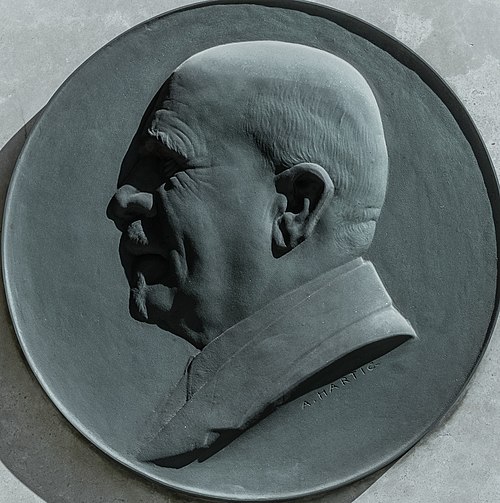
Photo 1:
sv.m.wikipedia.org/wiki/Fil:Alfons_Dopsch.jpg
Source:
Youtube youtu.be/I09RgyPfyh8?si=lce9nyx7ETZIfWDU
it.wikipedia.org/wiki/Alfons_Dopsch (Wikipedia)
sv.wikipedia.org/wiki/Alfons_Dopsch (Wikipedia)







Rispondi